
The pet food industry is currently at a crossroads between sustainability and operational efficiency. As consumer demand for eco-friendly packaging surges, brands are moving away from traditional multi-layer laminates toward recyclable mono-material films. However, these sustainable structures introduce a physics problem: they are notoriously difficult to seal at the high speeds required for modern pet food production.
For vertical form fill seal (VFFS) systems, the challenge is two-fold. You must maintain the integrity of the seal while navigating the narrow thermal properties of green materials. By leveraging advanced mechanical synchronization and thermal management, modern VFFS systems are turning these sustainability hurdles into a competitive advantage.
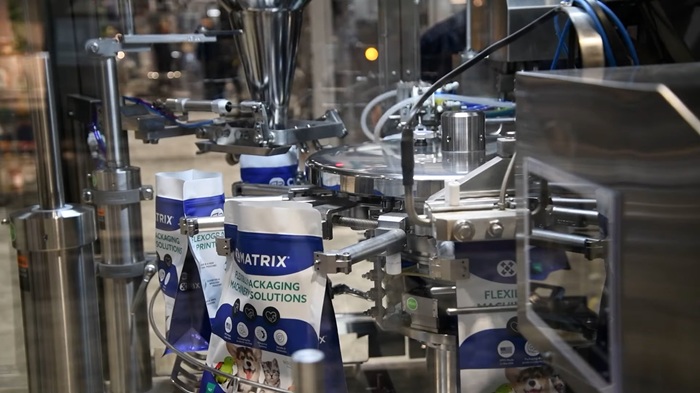
Why is “Charge Separation” the Secret to High-Speed Sealing?
When running lightweight or irregularly shaped products, like kibble or jerky treats, at high speeds, the primary mechanical hurdle isn’t just the machine’s cycle rate; it’s the physics of the product drop. Maintaining seal integrity while pushing speeds depends entirely on clean delivery and charge separation.
If a product “strings out” or leaves particulates or dust in the seal area, the integrity of the bag is compromised. To solve this, advanced continuous motion machines use:
- Stagers and Collection Buckets: Mechanical gates that ensure the product enters the bag as a distinct “charge,” leaving a clear window for the sealing jaws to close.
- Dynamic Product Timing: Utilizing a precise delay between the scale release and the jaw activation to ensure the product is fully seated before the seal is made.
- Continuous Motion Flow: Unlike intermittent systems, continuous motion allows the film to move constantly, reducing the violent “jerking” that can cause product to splash back into the seal area.
How do multi-zone heating systems solve the “Narrow Window” problem?
One of the most significant insights regarding recyclable films is that they possess a much narrower sealing window than traditional laminates. Traditional films have different layers with distinct melting points, making them forgiving. Mono-materials are sensitive; if you apply too much heat, the film melts or burns; too little, and it won’t bond.
The advancement that solves this is Discrete Zone Temperature Management. Instead of a single hot bar, modern systems utilize technology that breaks the sealing bar into multiple heating zones.
Benefits of Gradient Temperature Control:
- Compensating for Folds: In areas where the film is folded or layered (like side seals), the material is thicker and requires more heat. Discrete zones allow you to pump more energy into those specific areas without burning the thinner, single-layer sections of the web.
- Consistency Across the Web: It manages the temperature gradient across the entire width of the seal, ensuring that the edges and the center of the bag receive uniform thermal energy.
- Waste Reduction: By hitting the precise temperature required for recyclable PE or PP films immediately, manufacturers reduce the “burn-through” waste common during startup.

What Engineering Choices Drive Versatility and Changeover Speed?
In the pet food world, a single line might run pillow bags of kibble in the morning and gusseted bags of treats in the afternoon. Engineering for versatility requires moving away from manual adjustments toward automated axis control.
Modern systems utilize features like AutoPro, which replaces manual hand-cranks with small servo motors, screws, and linear guides. This allows for:
- Recipe-Based Adjustments: At the push of a button, every fundamental axis on the machine, including film tracking and registration, adjusts to a pre-saved position.
- Tool-less Forming Tube Changes: While the tube itself must be physically swapped, two-clamp lever releases make the process fast and repeatable, requiring no specialized tools.
- Automated Film Tracking: Servo-driven edge guides ensure the film stays centered, even if a recyclable film is slightly “stretchy” or inconsistent in tension.
Solving for Hygiene: How Does Metallurgy Affect Product Safety?
Pet food, particularly wet or oily varieties, requires a high level of sanitary design to prevent bacterial growth and withstand harsh cleaning chemicals. The engineering choices here are as much about chemistry as they are about mechanics.
Sanitary Engineering Breakdown
| Feature | Design Choice | Operational Benefit |
| Frame Construction | 304 Stainless Open Channel | Prevents water/bacteria from pooling in “pockets.” |
| Surface Geometry | Sloped & Minimal Horizontal Surfaces | Ensures water and particulates flush readily to the floor. |
| Weld Quality | Continuously Ground & Polished | Eliminates “beads” where bacteria can hide. |
| Component Material | Stainless Steel or FDA Plastic | Replaces brass/aluminum to resist corrosion from harsh chemicals. |
| Liquid Management | Drip Pans with Tri-Clamp Drain Ports | Routes washdown water directly to the drain to prevent standing water. |
The Future of Sustainable Pet Food Packaging
The transition to recyclable films is no longer optional; it is a market requirement. However, as the transcript of industry experts suggests, the bagger is only as effective as its ability to manage the physics of the material and the product.
By prioritizing charge separation for speed, multi-zone heating for film integrity, and sanitary stainless construction for safety, pet food processors can successfully adopt sustainable films without sacrificing the high-OEE (Overall Equipment Effectiveness) that keeps their operations profitable.
The goal is a “future-proof” system, one that is ready to seal the sustainable films of today and the bio-plastics of tomorrow. For more information on how Matrix systems can help you navigate these challenges, visit Matrix Packaging Machinery.
Subscribe to our email list for the latest in flexible packaging news.
